
LYING, CHEATING & STEALING IN ACTION
A Happy Curmudgeon series.
First, a word about how these posts get made. I use Claude, an AI assistant from Anthropic, as a research and drafting partner. On a post like this one, Claude does a good share of the legwork: it digs up the facts and sources and hands me a first draft. Then I do what I’ve done for 50 years with every writer’s copy, my own included. I review and edit it and keep only what I stand behind. I’m telling you this upfront because a column that calls out lying and cheating had better not be sneaking anything past you itself.
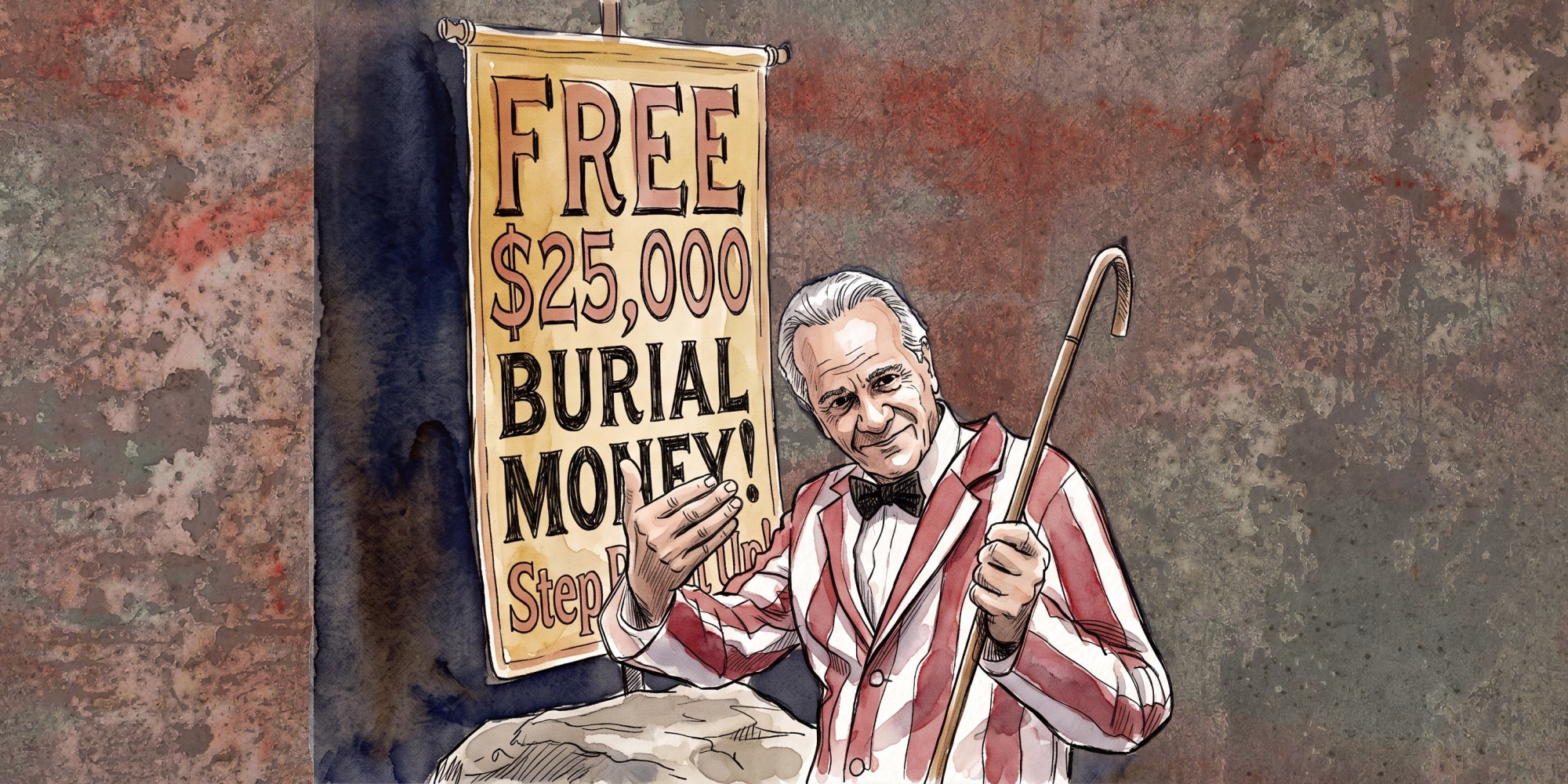
I’ve reached the age where television thinks I’m about to die.
Commercials are featuring “spokespeople” who want to know if I’ve “made arrangements.” A soft-focus mom reassures her grown daughter that the funeral is handled. A chipper announcer tells me I may qualify for up to $25,000 in burial coverage through a “state-regulated program,” and that the benefit “may not have been disclosed” to me.
Not disclosed? By whom? The state of Colorado, which apparently has been sitting on 25 grand with my name on it and forgot to mention it?
Let me save you the phone call. There is no $25,000 government burial program. Not state, not federal, not local. Social Security’s “lump-sum death payment” is $255, and only a surviving spouse or eligible child can collect it. That figure hasn’t changed since 1954. You can’t bury a goldfish on it anymore. So what’s actually going on? Something older than television.
You’re not the customer. You’re the product.
The companies behind many of these ads aren’t insurers. They’re lead generators. Their business is collecting your name, age, phone number and the name of whoever you’d like to leave money to, then selling that information to insurance agents. Often to several of them. Often more than once.
This is not a guess. The lead industry publishes its price lists. One company’s current rate card shows a fresh, exclusive final-expense lead goes for about $50. A live phone transfer, where you’re handed straight to an agent while still on the line, runs $110. Older leads sell for as little as a quarter apiece. Somewhere, right now, a 78-year-old widow’s curiosity is being auctioned like a used lawnmower.
And the ad that promised “no one will contact you”? Read the fine print that flashes by faster than a pharmaceutical side-effects list. It says your information will be shared with agents who will contact you. People who’ve responded report calls day and night, and agents turning up on the front porch.
“State-regulated” is the tell.
The phrase “state-regulated” is technically true. Every life insurance policy sold in America is regulated by a state. Calling a private policy “state-regulated” is like calling a cheeseburger “FDA-inspected.” Accurate, and designed to make you think the government is buying lunch.
Regulators have noticed. Insurance departments in Texas and Florida, and Pennsylvania’s attorney general, have warned consumers about mailers implying state sponsorship. The insurance industry’s own model advertising rules bar ads that imply government endorsement. In August 2025, the Federal Trade Commission extracted $145 million in settlements from two big insurance lead-generation outfits in the health insurance market. Among the allegations against one of them, MediaAlpha: websites dressed up to look government-affiliated, a made-up “give back program,” and paid actors posing as satisfied customers. MediaAlpha sold some 119 million leads in 2024 alone. That’s not a side hustle. That’s an industry.
What you’re really buying.
Say you take the bait and buy. What do you get? Often a guaranteed-issue whole life policy. No health questions, which sounds great until you learn the catch. Many of these policies pay only a refund of premiums, plus a little interest, if you die of natural causes in the first two or three years. And they cost more. A few years ago, Kiplinger ran the numbers for a healthy 70-year-old man buying $10,000 of coverage: roughly 50% more per month for the no-questions policy than for one with a medical exam.
So the “benefit you didn’t know about” turns out to be a product you pay extra for, which may not pay out if you die on schedule for your age bracket.
A word from the Circus.
I started my career marketing Ringling Bros. and Barnum & Bailey Circus. People love to quote P.T. Barnum’s line about a sucker being born every minute. Barnum almost certainly never said it. But he did understand that people will pay to be fooled, as long as they’re in on the joke.
These ads are the opposite. There’s no wink, and nobody watching is in on the joke. They’re built to make older people believe an entitlement exists, then sell that belief to the highest bidder.
The Curmudgeon’s advice
- If an ad says “state program,” “government benefit” or “not disclosed to you,” change the channel.
- If you want burial coverage, get quotes from an independent licensed agent who names the carriers they represent, and ask whether the policy pays in full from day one.
- Weigh your options against plain old savings earmarked for the purpose. No premiums, no waiting period, no strangers on the porch.
- Report deceptive ads at ReportFraud.ftc.gov or to the Colorado Division of Insurance.
As for me, I’ve made my arrangements. They involve ignoring the television.
Sources
- InsureLeads: Final Expense Lead Pricing
- Voices for Safety: The $25,000 Life Insurance Scam
- FexGuy: State Regulated Life Insurance
- FexGuy: Is the T2 Form a Scam?
- Mac Murray & Shuster: FTC’s $145M Blitz
- SteelEye: MediaAlpha FTC Fine
- Kiplinger: Don’t Fall for That Life Insurance Ad on TV
- Choice Mutual: Is There Free Burial Insurance?
- SSA: Lump-Sum Death Payment
- FTC: Assurance IQ and MediaAlpha to Pay $145 Million
- NAIC Model Regulation 570: Advertisements of Life Insurance

